1. Product introduction
The four-wave shear interference wavefront sensor has the following features: (1) the structure and optical path of the measurement system are simple; (2) The time coherence of the light source is not high; (3) Able to operate in low light; (4) It does not have high requirements for the measurement environment, and it is measured online and in real time; (5) There is no uncertainty problem of 2π in measurement, and thewavesurface inclination is the same, which does not affect the measurement results, so it is widely used in laser wavefront measurement, optical system assembly, optical metasurface measurement and biomedical fields.
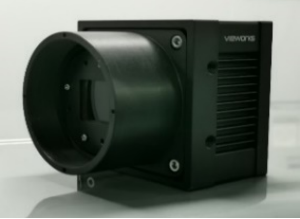
Four-wave shear wavefront sensor in kind
2. Features
-- Wavefront distortion PV, RMS, ZERNIKE ABERRATION/LENGDER ABERRATION, STRELLI RATIO (SR), point spread function (PSF), line spread function (LSF), modulation transfer function (MTF) measurement work
Energy Module;;
-- Real-time dynamic measurement and multiple average measurement, relative measurement and absolute measurement;
-- Manual and automatic setting of measurement mask
-- Non-uniform light field wavefront measurement;
-- Frequency response characteristics close to uniform response per unit;
-- Operating wavelength includes visible-near-infrared spectroscopy measurement range;
3. Key technologies
? Simulation design of hybrid modulation grating;
? system coupling;
? shear calibration;
? Path-guided four-wave shear interference wavefront reconstruction method.
4. Technical parameters
? Measurement band: visible - near-infrared
? Resolution: 512*512
? Measurement repeatability: RMS better than 0.005 λ
? Absolute measurement accuracy: RMS is better than 0.01λ